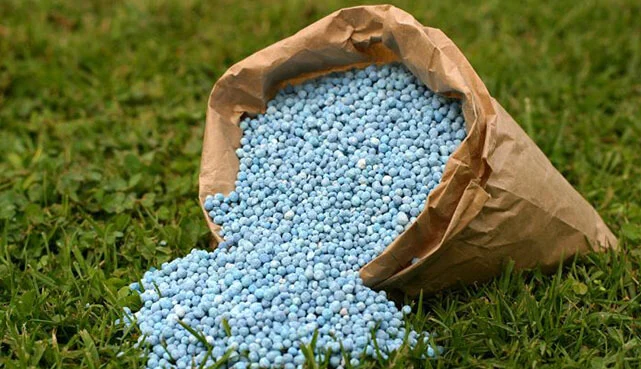
Every bag of compound fertilizer carries three numbers. Most people know they mean nitrogen, phosphorus and potassium. Rather fewer know that two of the three are not measuring the element named, which makes comparing products harder than it should be — and occasionally produces expensive mistakes.
What the numbers are
An NPK grade of 20-10-20 means, by weight:
- 20% nitrogen (N) — expressed as the element
- 10% phosphorus pentoxide (P₂O₅) — not elemental phosphorus
- 20% potassium oxide (K₂O) — not elemental potassium
The oxide convention is a historical legacy of how these nutrients were once analysed. It has survived because fertilizer regulation in most of the world is written around it, so changing it now would cause more confusion than it solved.
The conversions
| To convert | Multiply by | Example |
|---|---|---|
| P₂O₅ → P | 0.436 | 10% P₂O₅ = 4.4% P |
| P → P₂O₅ | 2.29 | 10% P = 22.9% P₂O₅ |
| K₂O → K | 0.830 | 50% K₂O = 41.5% K |
| K → K₂O | 1.205 | 50% K = 60.3% K₂O |
| CaO → Ca | 0.715 | 26.5% CaO = 18.9% Ca |
| MgO → Mg | 0.603 | 16% MgO = 9.6% Mg |
This matters more than it sounds. Fertigation targets and tissue analysis results are usually expressed as elements, while fertilizer bags are labelled as oxides. Mixing the two conventions in one calculation produces errors of over 100% for phosphorus.
The mistake that costs money
Hydroponic and fertigation recipes are normally written in mg/L of the element. So if a recipe calls for 40 mg/L of P and you calculate your dose using the P₂O₅ figure on the bag, you will apply roughly 2.3 times too much phosphorus.
Similarly, when comparing a US product labelled in oxides against a technical specification quoting elements, convert one to the other before drawing any conclusion. Otherwise the comparison is meaningless.
Ratio versus concentration
These are different things and the distinction is regularly lost.
20-20-20 and 10-10-10 have the same ratio — 1:1:1 — but the first is twice as concentrated. To supply the same quantity of nutrient you apply half as much 20-20-20.
This means comparing bag prices between products of different concentration tells you nothing. A cheaper 10-10-10 may cost more per unit of nutrient delivered than a more expensive 20-20-20, and it also costs more to ship, store and handle per unit of nutrient — which matters a great deal on an international order.
Calculating cost per unit of nutrient
For a single-nutrient product the arithmetic is simple:
cost per kg of nutrient = price per bag ÷ (bag weight × nutrient % ÷ 100)
A 25 kg bag of 0-0-50 potassium sulphate contains 12.5 kg of K₂O. A 25 kg bag of 13-0-46 potassium nitrate contains 11.5 kg of K₂O plus 3.25 kg of N. Compare on that basis, allowing for the value of the nitrogen.
For compound fertilizers, value the individual nutrients using single-nutrient prices, then compare against the compound. Compounds usually cost more per unit — you are paying for the convenience of one product instead of three, which is often worth it.
What the third number does not tell you
Two products with an identical NPK grade can behave completely differently. The grade says nothing about:
Which chemical form supplies the nutrient
Nitrogen can be nitrate, ammonium or urea. Plants take up nitrate directly; ammonium must be converted and acidifies the root zone; urea must be hydrolysed first. Two 20-0-0 products can produce quite different results depending on the mix.
What else comes along with it
Potassium can be supplied as chloride, sulphate or nitrate. Potassium nitrate and potassium sulphate are chloride-free; muriate of potash supplies substantial chloride, which several high-value crops tolerate poorly. The K₂O figure is identical in principle; the agronomic outcome is not. We compare the three here.
Solubility and insoluble residue
For fertigation, this is decisive. A soluble grade dissolves fully; an agricultural grade of the same analysis may leave residue that blocks filters and emitters. The NPK numbers are the same. The consequences are not.
Micronutrient content
“+TE” or “with trace elements” indicates micronutrients are included, but the grade does not say which, at what rate, or whether they are chelated. Check the full analysis.
Choosing a ratio for the growth stage
As a general orientation:
- Balanced (1:1:1) — general purpose, establishment and early vegetative growth. 20-20-20 is the standard.
- High nitrogen (3:1:2 or similar) — active vegetative growth, leafy crops.
- High phosphorus — rooting and establishment. Requirements are lower than most programmes assume; excess phosphorus reduces zinc and iron availability.
- High potassium (1:0:2 or higher) — fruit fill and quality. Potassium demand rises steeply once fruiting begins.
- No nitrogen (0-52-34) — MKP at flowering, when extra nitrogen would push vegetative growth at the wrong moment.
Actual rates should come from soil and tissue analysis, your crop’s requirement and local recommendations — not from a ratio chosen off a chart.
A worked comparison
Two quotations for potassium, delivered:
- Product A: potassium sulphate 0-0-50, 25 kg — supplies 12.5 kg K₂O and 11.25 kg SO₃
- Product B: potassium nitrate 13-0-46, 25 kg — supplies 11.5 kg K₂O and 3.25 kg N
Per bag, A supplies more potassium. But B also supplies nitrogen you would otherwise buy separately, and dissolves considerably faster. If your crop is chloride-sensitive both are suitable; if you need sulphur, A has the advantage; if you are fertigating and want speed of dissolution, B does.
The NPK numbers start the comparison. They do not finish it.
Summary
- N is elemental; P and K are expressed as oxides. Convert before comparing with a recipe or a tissue analysis.
- Ratio and concentration are different things — compare cost per unit of nutrient, not per bag
- The grade says nothing about nutrient form, accompanying ions, solubility or trace elements
- For fertigation, solubility and insoluble matter often matter more than the headline numbers
If you would like a quotation compared properly, send us the specifications you are looking at. We will work through the arithmetic — including where a competing product is genuinely better value. Browse the water-soluble range or read the fertigation guide.
Need this product, or advice on which grade fits?
Send us the crop, your water analysis and the quantity you need. We will reply with the options that actually apply to your situation.